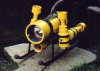
Rov Reboot (3D Printed Rov)
Re: Rov Reboot (3d Printed)
Back to work on the end cap... I bored out the recesses today to make room for the camera now I just have to drill some holes for the penetrators.
The spring pressure idea of the original camera mount was not going to be secure enough so I had to redesign the main camera mount so it could screw to the end cap. This should keep everything nice and tight and in place.
Re: Rov Reboot (3d Printed)
As a quick side project and basically just out of curiosity to see if 3D printed parts would handle any kind of pressure and actually be waterproof I printed up a endcap to my camera housing to test out in the pressure chamber.
The o-ring seal on the tube looks good but I don't know how well they will seal against the printed surface if the surfaces of the part will actually stop the water. Even printed at 100% infill with 4 outer shells all around I don't have high hopes that it will work but its worth a shot just to know once and for all.
It's in the chamber now and I'm going to leave it in there for at least an hour before I check on it. As suspected... it didn't work.
I'm not exactly sure of where it leaked but you can see water and air in between the two o-rings so I'm guessing everywhere... 
It's in the chamber now and I'm going to leave it in there for at least an hour before I check on it. As suspected... it didn't work.
Re: Rov Reboot (3d Printed)
Ok back to the real end cap... I drilled and tapped 5 holes for the 4-40 brass screws I will be using for penetrators. I wraped the screws with a bite of thread sealing tape before inserting them in the cap.
Here they are on what will be the inside of the tube...
...and here the are on the water side. I planned on secure the wires on this side with nuts but really don't have the room so I might have to machine other threaded fittings if I want to be able to remove the pod from the Rov.
Wires are soldered to the bolt heads on the inside for the camera and tilt motor. I might just solder the water side wires on too in the long run.
It's back in the chamber being tested now. Once again to be continued....
Re: Rov Reboot (3d Printed)
Tonight's test saw the slightest bit of water in the tube. I'm not sure if its from the new penetrators or not so I'll have to retest it tonight with the tube stuffed with some tissue and paper towels to determine exactly where the leak is coming from. If it is from the penetrators I can just seal them by filling the recess with epoxy if it comes to that.
I'm also testing at a simulated depth of 200' and this Rov only has a 100' tether so the working depth is more around the 75' mark. (which it will probably never see anyway.)
Re: Rov Reboot (3d Printed)
To test where the leak is coming from I stuffed some tissue paper in above the penetrators and then put another piece loose in the housing. What this shows is if the tissue is wet where the penetrators are that's where the water is coming in and if the loose piece is wet it's the o-rings.
Well it turns out it is the penetrators. Looking closely I can now see I got them too hot soldering the wires on and you can see they melted into the housing. I'm sure the threads deformed enough to allow water to past through and it just goes to show what pressure can do. I'm sure they would still work at the depths I will be running but I'll just go ahead and use some epoxy to seal them up so I can move on with the build.
-Steve
-Steve
Re: Rov Reboot (3d Printed)
I like your idea for the penetrators. I think I've been over-thinking mine.
Why not solder or crimp the wires to ring terminals then put the brass screws through them? Saves soldering directly to the screws and melting your cap.
You might also find that the screw threads themselves leak no matter what. In the industry, any screw penetrating a one atmosphere housing would have an o-ring under the head and a seat machined into the housing to take the o-ring.
Why not solder or crimp the wires to ring terminals then put the brass screws through them? Saves soldering directly to the screws and melting your cap.
You might also find that the screw threads themselves leak no matter what. In the industry, any screw penetrating a one atmosphere housing would have an o-ring under the head and a seat machined into the housing to take the o-ring.
Re: Rov Reboot (3d Printed)
I originally planned on using ring terminals on the outside but for some reason it never crossed my mind to do it on the inside too.
I figured the teflon tape would work enough for the depths I and going to be using this but yeah an o-ring under the head probably would have been a better idea next time I'll give that a try.... thanks.
-Steve
-Steve
Re: Rov Reboot (3d Printed)
I added some epoxy to reinforce the sealing of the connectors.
On to the wiring... running the wires through the camera shaft was a bit of a pain I should have done this before gluing the camera mount to the shaft. I didn't have much room to solder on the motor wires either as I couldn't leave to much slack in the cap.
I was able to squeeze all the wires in there and get the camera mount screwed to the end cap.
Next I cut the plug off the camera cable and spliced it into the wires on the end cap.
So far so good... Next I have to attach the tether wires to the end cap and test the camera feed. I'll probably have to machine some small screw on fittings to do this as I don't want to try soldering to the through connectors again.
Re: Rov Reboot (3d Printed)
Tonight I started to wire the camera to the camera cable in the tether. Originally I just cut the plugs off the camera cable going through the tether (and recently off the camera) figuring I would just solder them back on later and plug all the plugs together. Well I wasn't sure how the plugs would fare open to the water so I decided to just leave all the plugs off and try to solder the wires from the cable to the through connectors. (plus there there was the fact that I misplaced the plugs that go back on the cable end.
) It took a bit of trial and error with the multimeter to figure out which wire was what. I figured in the camera cable the black and red would be power and the white would be video and the other bare wire was some type of shield.... it turns out that was not the case as I forgot this cable is wired for sound too. The bare wire was the ground (and shield?), the white was the Positive, the black was Video, and the Red was sound. (maybe I'll go back and add a speaker just for the hell of it.) I also had to splice on a new power connector because the one that came on the camera cable was a size I've never seen before.
On the Rov side for now I just soldered on some alligator clips for testing purposes. I used the clips to temporally connect the wires to the through connectors.
I hooked the feed up to my basement TV and holding my breath I plugged in the power adapter... surprisingly enough everything was correct and I have a picture. The image isn't to bad in color with some lights on but the camera switches to B/W in low light situations and I'm not sure how impressed I am with that quality yet. I'm definitely going to need to add on some flashlight or something.
Re: Rov Reboot (3d Printed)
I almost forgot to drill and tap the camera pod mounting screw location so I took care of that before wiring up the camera.
Next I had to machine up some tiny retainer nuts for the through connectors.
I'm just making my own ring terminals by looping the wire around a larger 6-32" screw....
... and then hitting it with some solder to reinforce them.
The idea is to simply slip them on the 4-40" through connectors...
... and secure them with the nuts I machined.
This was a little more tedious then I imaged but I did get them all connected.
Now I just have to splice these wires into the camera cable in the tether, test the camera again, and figure out whats next.