H Bridge motor controller

Control Boards, Controllers, Tethers, Ect.
Post Reply
Sky
Posts: 13
Joined: Dec 31st, 2010, 5:54 am

H Bridge motor controller

Post by Sky »

Hello everyone :)

I been thinking about using h bridges as motor controllers. Ive been looking at some transistor based ones but read that they have much higher power loss compared to mosfets, so I'm thinking about using those instead. Problem is I don't really know much about mosfets :mrgreen: so I was hoping someone could help me with what mosfets I could use to make a controller that can handle about 10 amps (all i really know is they have to have a low on resistance...)
I'm planning on controlling the controllers via a arduino. If ive read correctly then if they are powered directly by the arduino they need to be logic mosfets but if i use transistors or a IC H bridge
between the mosfets and the arduino then I can use any, is that correct?
All of the ones I've looked at have a ground and 1 PWM wire for each direction. Is it possible to modify them/add some more circuitry so that there is only a ground and 1 PWM wire for both directions? (so its like a rc esc/servo). How would I go about doing this?
Also If anyone knows of any schematics for a H bridge controller that they could recommend that would be a great help since I've looked at so many and they all a bit different :?

Any help appreciated
Thanks
Philipp
derelicte
Posts: 292
Joined: Aug 1st, 2011, 3:08 pm

Re: H Bridge motor controller

Post by derelicte »

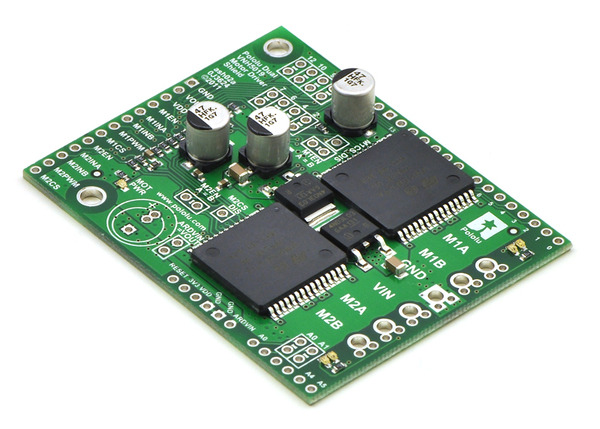
you might just want to consider buying something like this:

Image
http://www.pololu.com/catalog/product/2502

it plugs right onto an arduino.
martinw
Posts: 91
Joined: Sep 20th, 2011, 11:02 am
Location: Aberdeenshire

Re: H Bridge motor controller

Post by martinw »

sKooTr
Posts: 10
Joined: May 28th, 2011, 10:33 am

Re: H Bridge motor controller

Post by sKooTr »

I am trialling 3 LMD18200's: http://www.national.com/pf/LM/LMD18200.html#Overview.

They seem to work fine, on a breadboard, out of the water, so far ! Expensive though ....

I am using them with 1 PWM, 1 direction, and 1 ground connection. They also support a single combined PWM / direction signal.

Scott
derelicte
Posts: 292
Joined: Aug 1st, 2011, 3:08 pm

Re: H Bridge motor controller

Post by derelicte »

I've looked at that part. 3a isn't really enough.
User avatar
thegadgetguy
Posts: 238
Joined: Feb 13th, 2011, 8:27 pm
Location: Pennsylvania

Re: H Bridge motor controller

Post by thegadgetguy »

Yea, no way is 3 amps enough, go with at least 10 for bilge pumps. I see you know to go with the logic level MOSFETS. You should be able to rig up a proportional two direction control system with a ground, a PWM pin, and one more pin to control direction pretty easily. Doing it with only a ground and a PWM pin from the Arduino would require a lot more circuitry. Depending on how many thrusters you have, the Arduino Uno might not have enough ports. Remember, the Arduino and all the MOSFETS will share the same ground, leaving you with essentially one PWM port and one directional port per thruster. Good Luck!
Sky
Posts: 13
Joined: Dec 31st, 2010, 5:54 am

Re: H Bridge motor controller

Post by Sky »

Thanks for all the replies

If the mosfets are logic level does that mean the the gate to source voltage is 5v? Also if the gate to source voltage is lets say 20v does that mean the mosfet needs to receive 20v in order
to open? If I use another microprocessor between the arduino and the mosfets they dont need to be logic level do they? Im not quite sure though what mosfets I should use that are suitable, (to handle max 10amps) does anyone have any suggestions?

Philipp
User avatar
thegadgetguy
Posts: 238
Joined: Feb 13th, 2011, 8:27 pm
Location: Pennsylvania

Re: H Bridge motor controller

Post by thegadgetguy »

"Logic Level" is a somewhat loosely used term, but it basically means that you can turn on the MOSFET using only 5 volts, whereas a normal MOSFET needs about 10 volts. So to use a MOSFET with an Arduino and most other microprocessors, you would need logic level ones. I think that you are correct with your second question, all though most MOSFETs are in the 7-10 volt range (not counting logic level ones). I'm not sure what you mean by a microprocessor between the Arduino and the MOSFET, but you would still need logic level MOSFETs unless the microprocessor was boosting the voltage up higher. Hope this answers a few of your questions.
Post Reply